by Prune Engerant
December 2023

Last academic year, I had the opportunity to work as a research assistant for the Imaging the Psalter Project (led by Professor Adam Cohen, University of Toronto and Professor Heather Pulliam, The University of Edinburgh) whilst completing my undergraduate degree in History of Art and English Literature at the University of Edinburgh. This was a great chance to engage with the illustrated programs of a large range of early illuminated psalters (700-1200), an interest which I am currently continuing to pursue through my MA degree in Medieval Art History at the Courtauld Institute.

For the project, each research assistant was assigned three to four main psalters to look at and engage with. I focused on the Corbie Psalter (c. 800), the Utrecht Psalter, (820), the Harley Psalter (c. 1050-1100) and the Bury Psalter (c. 1399-1415)––four vividly decorated medieval books which I had only briefly encountered prior to this study. For each of these, we first created an excel spreadsheet so that we could record the location of the first twenty psalm illustrations within the manuscript matrices through hyperlinks to their digitised folios. This proved a useful task, not only in providing a quick access to our ten selected core psalters but also in allowing us to familiarise ourselves with psalter structures and digital repositories. Indeed, with medieval manuscripts increasingly being made accessible online through the digital libraries of the British Library, the Vatican Library, and the Bibliothèque Nationale de France, amongst others, learning how to navigate these digital facsimiles became an important part of my work.
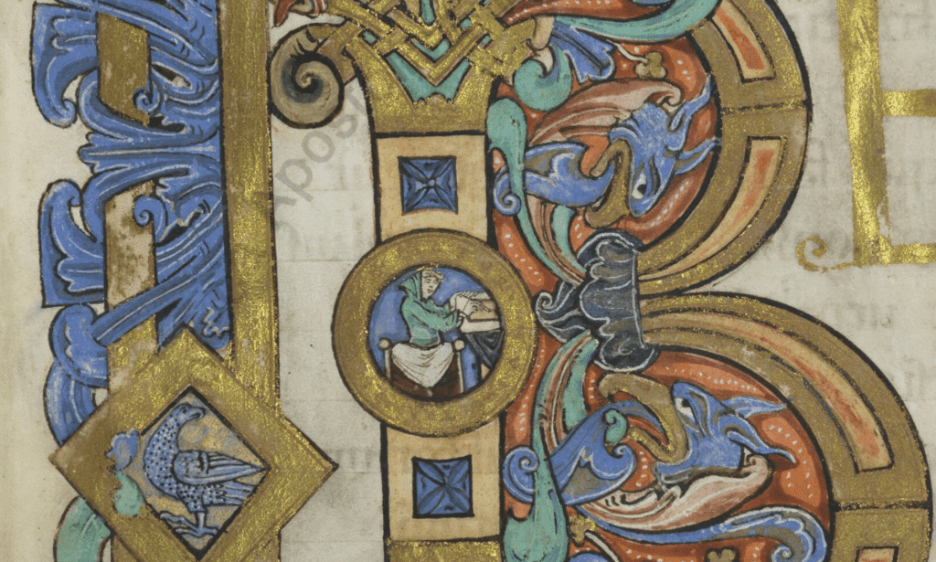
After completing this groundwork, a second document was made to record information regarding the images found in each manuscript, alongside the codices’ provenance, source, and any other additional notes (some French manuscripts, for example, had been destroyed in the second world war, thus making their images inaccessible except through pre–1939 textual sources). We initially categorised illuminations as ‘prefatory image,’ ‘frontispiece,’ ‘miniature,’ ‘historiated initial,’ and ‘decorated initial’. I really enjoyed this classification process as it required spending many hours carefully looking at the images which inhabited the psalter pages. Below, for example, is one illumination I encountered during the task. It depicts a scribal portrait detail contained within a richly decorated ‘B’ initial on folio 21r of the Bury Psalter (Rome, Biblioteca Apostolica Vaticana, Reg. lat. 12):
With the study exploring the relationship of word to image within early medieval psalters, we found it important to consider exactly what types of ‘images’ were relevant to record as we progressed in the project. Indeed, although the majority of manuscripts that were looked at contained a degree of decoration––as was recorded in Victor Leroquais’ 1940 study of illustrated psalters currently held within French libraries––not all of these decorative elements were pertinent to the project’s iconographic study. Some foliated decorative elements, for instance, although partaking in the overall visual value of the psalters, did not appear to carry any specific meaning.
Similarly, although distinguishing between historiated initials (with identifiable subject matters) and decorative inhabited initials (where the human or zoomorphic figure does not appear specific) was central to our initial taxonomy method, identifying these distinctions proved to be a challenging aspect of our work. Indeed, whilst within a specific context the decorative element may have held only a playful visual function, in another, these images could relate to the text and deepen our understanding of word-image dynamics. This is for example seen in two initials below, found in one of the glossed psalters (Troyes, Bibliothèque Municipale, MS 0976):
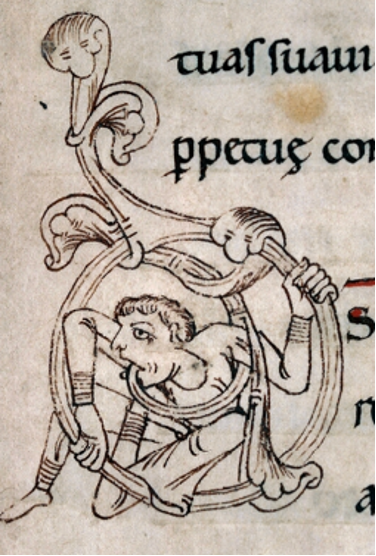
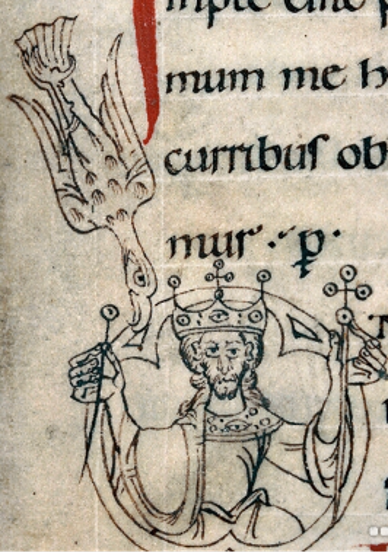
Whilst both initials sport the same degree of decoration, the king figure (crowned) on folio 20r may function as a potential identifier for either a precise historical figure or, at the very least, an archetype. Its relation to the text may therefore be different to its neighbouring decorative (albeit inhabited) initial.
As a result of this trial-and-error process, it was decided that instead of categorising initials into a ‘historiated’ vs ‘decorated’ binary, a more descriptive framework would be needed to ensure the long-term accuracy of our collected data and method. Short descriptions of the initial ‘type’, i.e. human, zoomorphic, architectural, foliate, will allow for the project to record the images contained in a large range of illuminated psalters with less recourse on potentially subjective interpretation.
I really enjoyed being part of this development first hand, seeing how the project and its demands necessarily shifted as we advanced and worked on it as a team. Learning this flexibility has also helped me in my current studies, showing me that research methodologies need to be able to respond to and accommodate the different primary materials we work with, and not the other way around.
I now look forward to seeing what the Imaging the Psalter Project’s wide scope of visual material––having taken a more holistic view of early psalter iconographies––will help bring to light for the field. It’s a hugely ambitious project but one which is needed so that we may not only understand individual pictorial matrices but also the movements and meanings of early psalters as corpus. It’s all very exciting and I wish the very best to Professor Cohen and Professor Pulliam on their ongoing study!
 imagingthepsalter.com