How might the digital humanities help us understand the complex word-image relationships and lost Late Antique models for early illustrated psalters? Might the complex iconography of medieval psalters help us develop new tools for analyzing visual data? This website, still in development, follows Prof. Adam S. Cohen (University of Toronto), Dr Heather Pulliam (University of Edinburgh) and their collaborators as they attempt to answer this and many other questions.
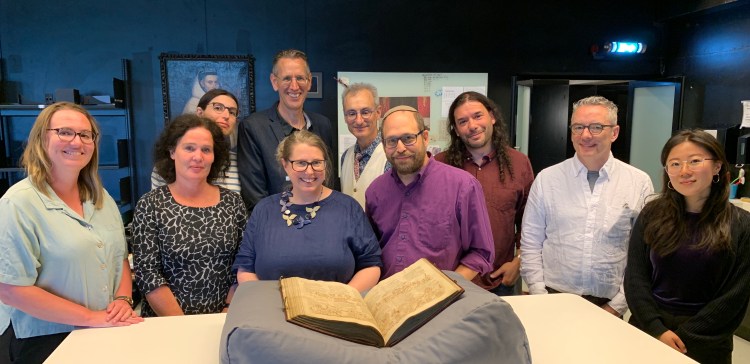
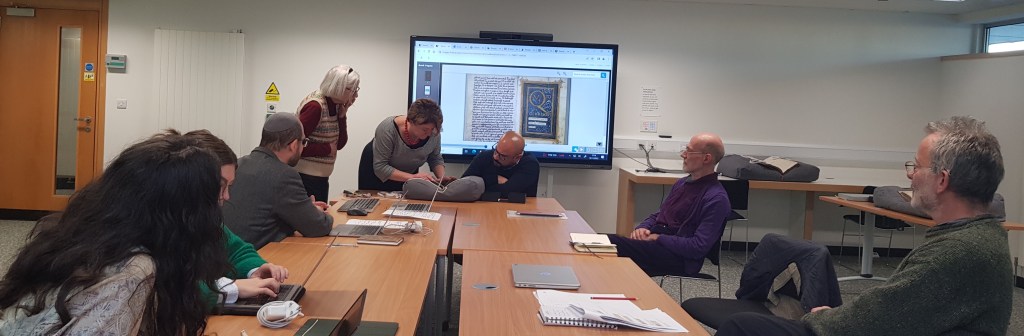
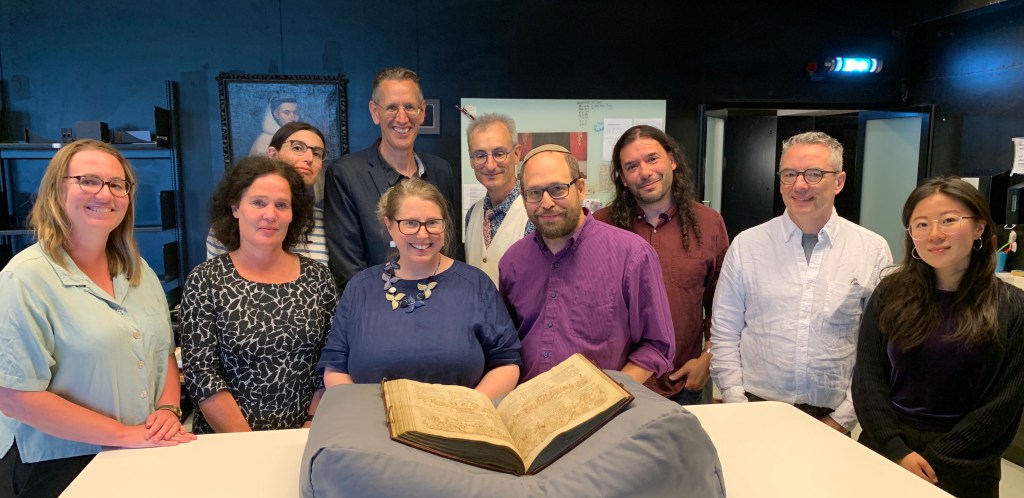
Utrecht Psalter Workshop 2022, Utrecht University Library
Chloe Bramwell, Lilli Steffens, Santa Maria Bouquet, Senior Conservator of the Heritage Collections of the University of Edinburgh
At the University of Edinburgh we are fortunate enough to have the Celtic Psalter (University of Edinburgh MS 56) within the university’s collections. It is usually dated to the 11th century, although much of its origin remains shrouded in mystery. It is frequently described as the earliest Scottish manuscript to remain in a Scottish collection. In November 2023, Prof. Heather Pulliam (University of Edinburgh) and Prof. Adam Cohen (University of Toronto) arranged a workshop at the Centre of Research Collections to bring together academics and students working in the field to attempt to learn more about the psalter, its origins, and later uses.
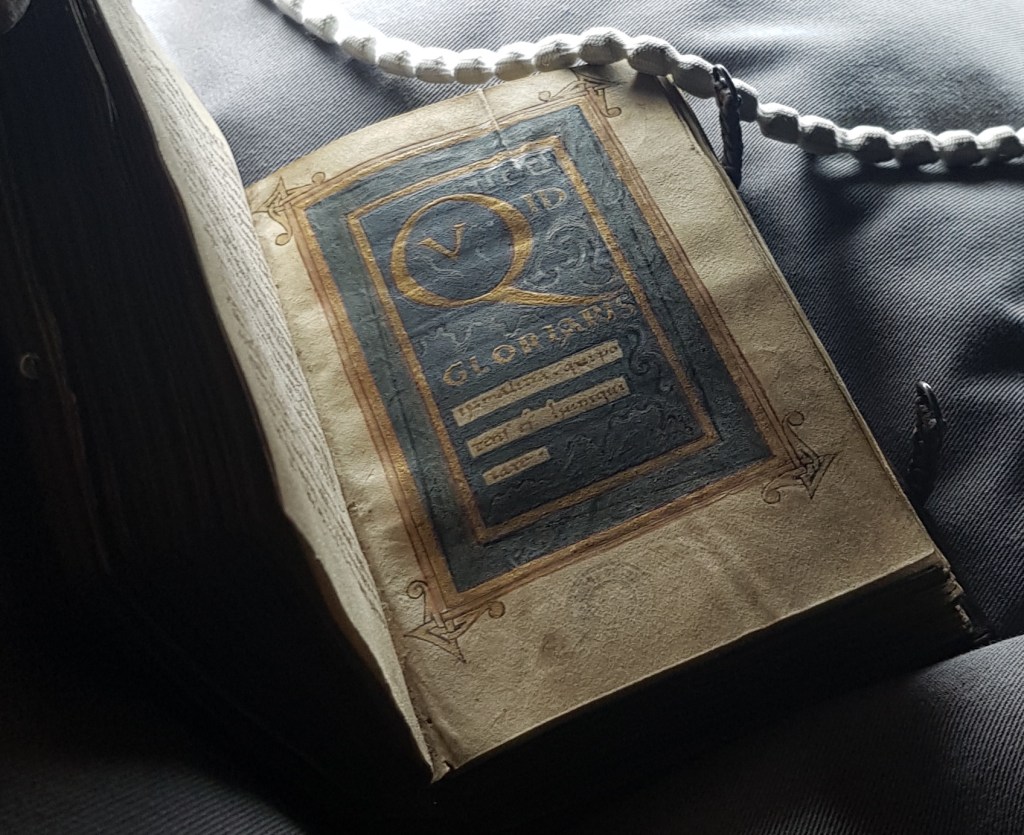
These included University of Edinburgh archivist Aline Brodin; Dr Beth Duncan, whose PhD thesis surveyed paleography in manuscripts from 1000-1200CE including the Celtic Psalter; Dr Carol Farr, Research Fellow at the Institute of English Studies, University of London; Dr Richard Gameson, Professor of the History of the Book at the University of Durham; Rachel Hosker, University Archivist and Research Collections Manager at the University of Edinburgh; Gilbert Márkus, Faculty Member at the Department of Celtic and Gaelic, University of Glasgow; Elizabeth Quarmby Lawrence, Rare Books Librarian at The University of Edinburgh; Jonathan Santa Maria Bouquet, Senior Conservator of the Heritage Collections of the University of Edinburgh. Two questions lay at the centre of the day: when was the codex written, and why was the decorative page for Psalm 51 (Psalm 52), ‘Why dost thou glory in malice?’ so out of place?
Psalm 51 (Psalm 52)
The day began with Adam Cohen, who is in Edinburgh as a Visiting Leverhume professor, giving an overview of the codicology of the psalter and in particular opening up the question of why a singleton page was introduced for Psalm 51, but not for similar decoration for Psalms 1 and 101. A recognisable feature of Insular psalters is the tendency to give decorative emphasis to Psalm 1, Psalm 51, and Psalm 101. The lively discussion which followed asked the question of whether the curiously painted page was a later addition, or if this single page was a quirk of the original codex. Looking at the construction of the book provided useful context for the creation of parchment books, and the process of their creation.
Dr Beth Duncan then presented on the manuscript’s paleography, and the sharp contrasts in the writing styles between different time and place in the Early and High Middle Ages. Using a combination of linguistic and paleographical analysis, Beth was able to place the original text as an example of late Insular minuscule somewhere in the 11th century. Later additions in Carolingian minuscule were added shortly after the manuscripts completion. As only 25 extant British manuscripts from the early 11th century remain it is difficult to say with certainty that this is when the manuscript dates from using paleography alone, however Dr Duncan was confident in saying that it was not a 12th century creation.
Moving onto pigment analysis, Dr Richard Gameson introduced us to his arsenal of non-invasive spectroscopic apparata at his disposal. Designed to be as sensitive and safe as possible to avoid damaging delicate materials, he explained how he used refraction of light to identify the various mineral and organic compounds used to create pigment throughout the Middle Ages. He then provided us with a timeline of when these pigments could be found in Britain from his work with ‘Team Pigment’ and their recent publication, The Pigments of British Medieval Illuminators: A Scientific and Cultural Study. While there are limitations in mapping British availability of pigment onto Insular manuscripts, it can at least give some indication of what is likely. Dr Duncan’s own research on contemporaneous manuscripts, such as the Coupar Angus Psalter, also helps point to fruitful answers to the many questions surrounding the Celtic Psalter.
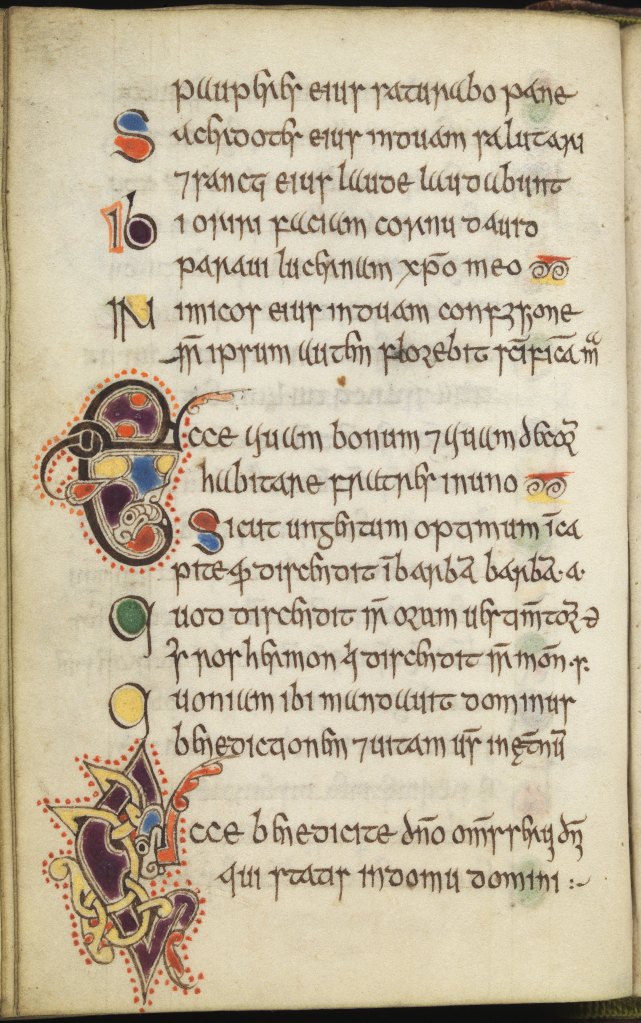
Next, Carol Farr gave an overview of the psalter’s illumination. Probably painted by a skilled artist, the initials are impressive. With Dr Farr’s analysis as guidance, it became clear to us how many different distinctive motifs one decorated letter could contain. It was especially interesting to see how these elements could be traced back to different artistic traditions, including Celtic and Scandinavian, which are also found in other Insular manuscripts from the same period. As history students who might instinctively focus on the content of the text, seeing the illustrations of a manuscript decoded and used in determining the provenance of the psalter in this way was fascinating, and showed us an entirely new approach to the non-textual side of manuscripts.
After lunch, it was time to return to the more mystifying parts of MS 56. There is no clear evidence for when and how the manuscript came to the University library, or at what point it was rebound before the current binding from 1914. Stamps on some of the pages, as well as partially legible shelf marks on the first folio, might place the psalter’s arrival in the library between 1750 and the nineteenth century. Tracing the manuscript’s journey brought us back to look at folio 50r (Psalm 51) once more, this time under better light and with the help of Dr Santa Maria Bouquet, the conservator. Peculiarly shaded lines gave the impression that there were indentations on the page, however, under the proper lighting this turned out to be more of an illusion. The page itself, covered in dark indigo (woad) paint (as opposed to the lapis lazuli used throughout the rest of the manuscript), does not reveal much of what might be lying underneath, at least not without modern scanning technology at hand. It remains to be seen whether the indigo covered up a different design or if underneath the paint there is just a sketch for the visible artwork.
In the end, as with most historical objects we, as students, have the privilege to inspect up close and in this case even touch, they become even more real, even more tangible when their history is explored. For us, being able to witness how the different parts of MS 56 might tell us how it was made, and how it ended up in our hands, was an immense privilege. The impressions we got from only a few hours of discussion will stay with us for the rest of our academic journey, and we are grateful for these insights into the workings of historical research and for the opportunity to learn from these incredible experts. For this, we would like to thank Richard Gameson, Carol Farr, Beth Duncan, Gilbert Márkus, as well as Aline Brodin, Elizabeth Quarmby Lawrence, Rachel Hosker and Jonathan Santa Maria Bouquet from the Special Collections, and of course Adam Cohen and Heather Pulliam for allowing us to be part of this workshop and this project. We are excited to see what else the Celtic Psalter might reveal to us in the future, and what answers may be found to the questions raised in the workshop.
Last academic year, I had the opportunity to work as a research assistant for the Imaging the Psalter Project (led by Professor Adam Cohen, University of Toronto and Professor Heather Pulliam, The University of Edinburgh) whilst completing my undergraduate degree in History of Art and English Literature at the University of Edinburgh. This was a great chance to engage with the illustrated programs of a large range of early illuminated psalters (700-1200), an interest which I am currently continuing to pursue through my MA degree in Medieval Art History at the Courtauld Institute.
Detail from Corbie Psalter, folio 1V (Amiens, Bibl. Mun., MS 018)
For the project, each research assistant was assigned three to four main psalters to look at and engage with. I focused on the Corbie Psalter (c. 800), the Utrecht Psalter, (820), the Harley Psalter (c. 1050-1100) and the Bury Psalter (c. 1399-1415)––four vividly decorated medieval books which I had only briefly encountered prior to this study. For each of these, we first created an excel spreadsheet so that we could record the location of the first twenty psalm illustrations within the manuscript matrices through hyperlinks to their digitised folios. This proved a useful task, not only in providing a quick access to our ten selected core psalters but also in allowing us to familiarise ourselves with psalter structures and digital repositories. Indeed, with medieval manuscripts increasingly being made accessible online through the digital libraries of the British Library, the Vatican Library, and the Bibliothèque Nationale de France, amongst others, learning how to navigate these digital facsimiles became an important part of my work.
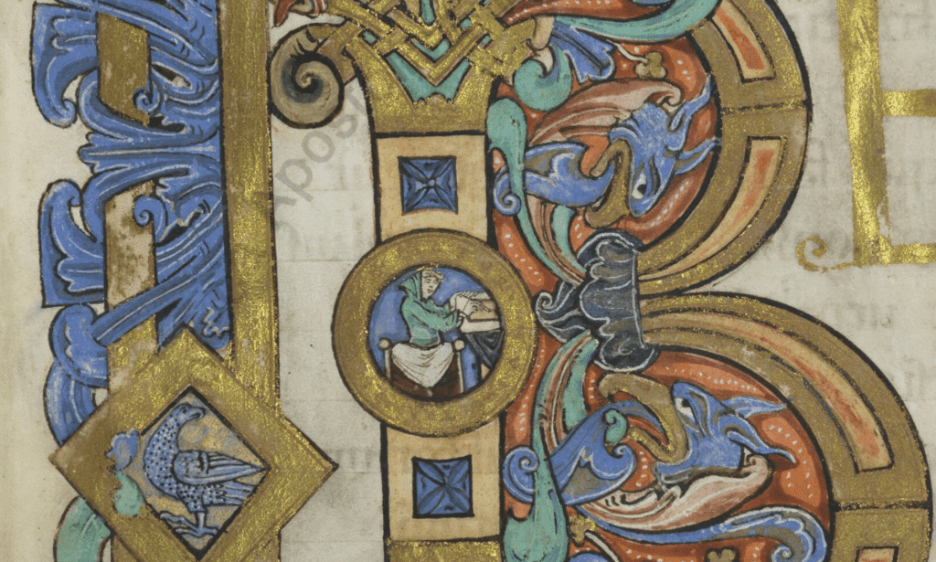
After completing this groundwork, a second document was made to record information regarding the images found in each manuscript, alongside the codices’ provenance, source, and any other additional notes (some French manuscripts, for example, had been destroyed in the second world war, thus making their images inaccessible except through pre–1939 textual sources). We initially categorised illuminations as ‘prefatory image,’ ‘frontispiece,’ ‘miniature,’ ‘historiated initial,’ and ‘decorated initial’. I really enjoyed this classification process as it required spending many hours carefully looking at the images which inhabited the psalter pages. Below, for example, is one illumination I encountered during the task. It depicts a scribal portrait detail contained within a richly decorated ‘B’ initial on folio 21r of the Bury Psalter (Rome, Biblioteca Apostolica Vaticana, Reg. lat. 12):
Rome, Biblioteca Apostolica Vaticana, Reg. lat. 12
With the study exploring the relationship of word to image within early medieval psalters, we found it important to consider exactly what types of ‘images’ were relevant to record as we progressed in the project. Indeed, although the majority of manuscripts that were looked at contained a degree of decoration––as was recorded in Victor Leroquais’ 1940 study of illustrated psalters currently held within French libraries––not all of these decorative elements were pertinent to the project’s iconographic study. Some foliated decorative elements, for instance, although partaking in the overall visual value of the psalters, did not appear to carry any specific meaning.
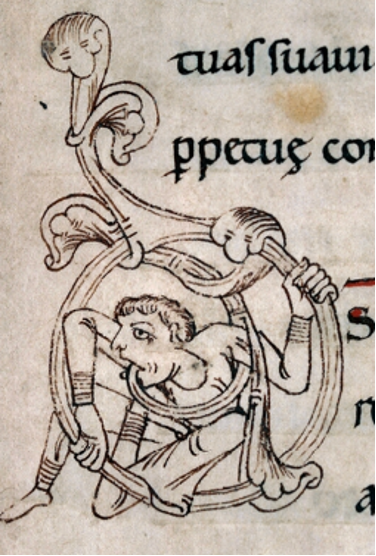
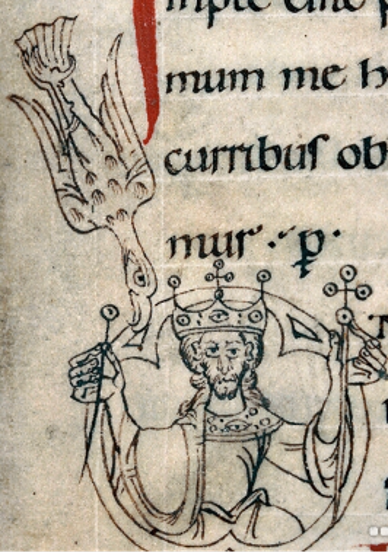
Similarly, although distinguishing between historiated initials (with identifiable subject matters) and decorative inhabited initials (where the human or zoomorphic figure does not appear specific) was central to our initial taxonomy method, identifying these distinctions proved to be a challenging aspect of our work. Indeed, whilst within a specific context the decorative element may have held only a playful visual function, in another, these images could relate to the text and deepen our understanding of word-image dynamics. This is for example seen in two initials below, found in one of the glossed psalters (Troyes, Bibliothèque Municipale, MS 0976):
Whilst both initials sport the same degree of decoration, the king figure (crowned) on folio 20r may function as a potential identifier for either a precise historical figure or, at the very least, an archetype. Its relation to the text may therefore be different to its neighbouring decorative (albeit inhabited) initial.
As a result of this trial-and-error process, it was decided that instead of categorising initials into a ‘historiated’ vs ‘decorated’ binary, a more descriptive framework would be needed to ensure the long-term accuracy of our collected data and method. Short descriptions of the initial ‘type’, i.e. human, zoomorphic, architectural, foliate, will allow for the project to record the images contained in a large range of illuminated psalters with less recourse on potentially subjective interpretation.
I really enjoyed being part of this development first hand, seeing how the project and its demands necessarily shifted as we advanced and worked on it as a team. Learning this flexibility has also helped me in my current studies, showing me that research methodologies need to be able to respond to and accommodate the different primary materials we work with, and not the other way around.
On June 15th and 16th 2022, an international group of a dozen researchers met at the Utrecht University Library (UUL) to discuss the development of digital tools for the study of the Utrecht Psalter and related medieval works. Spearheaded by Adam S. Cohen (University of Toronto) and Heather Pulliam (University of Edinburgh), hosted by Bart Jaski (Utrecht U. Library) and supported by a Partner Grant from the Toronto-Edinburgh Joint Call for Collaborative Projects, the workshop succeeded in bringing together people with a range of experience, questions, and ideas. We were also joined by our project research assistant, Emily Fu (U. of Edinburgh). We are so grateful to our host and the participants for their generosity in sharing their expertise and ideas:
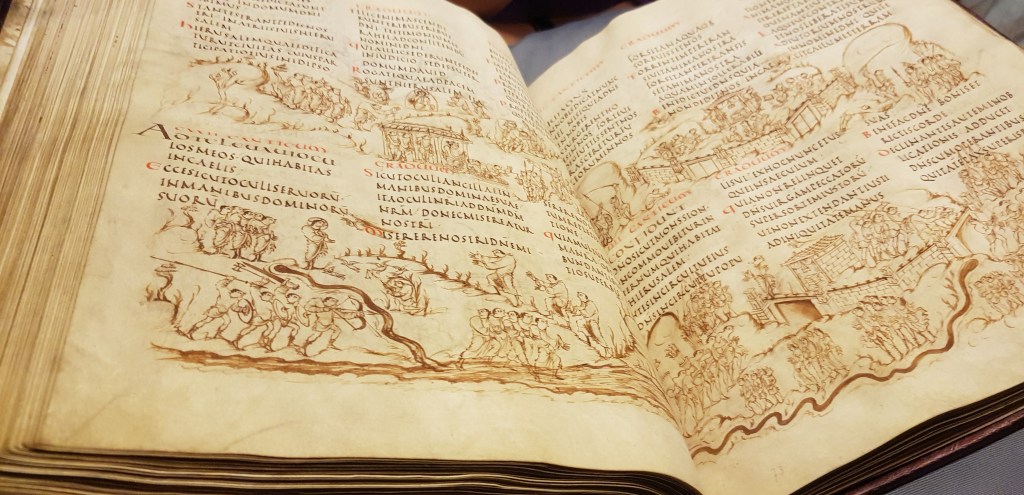
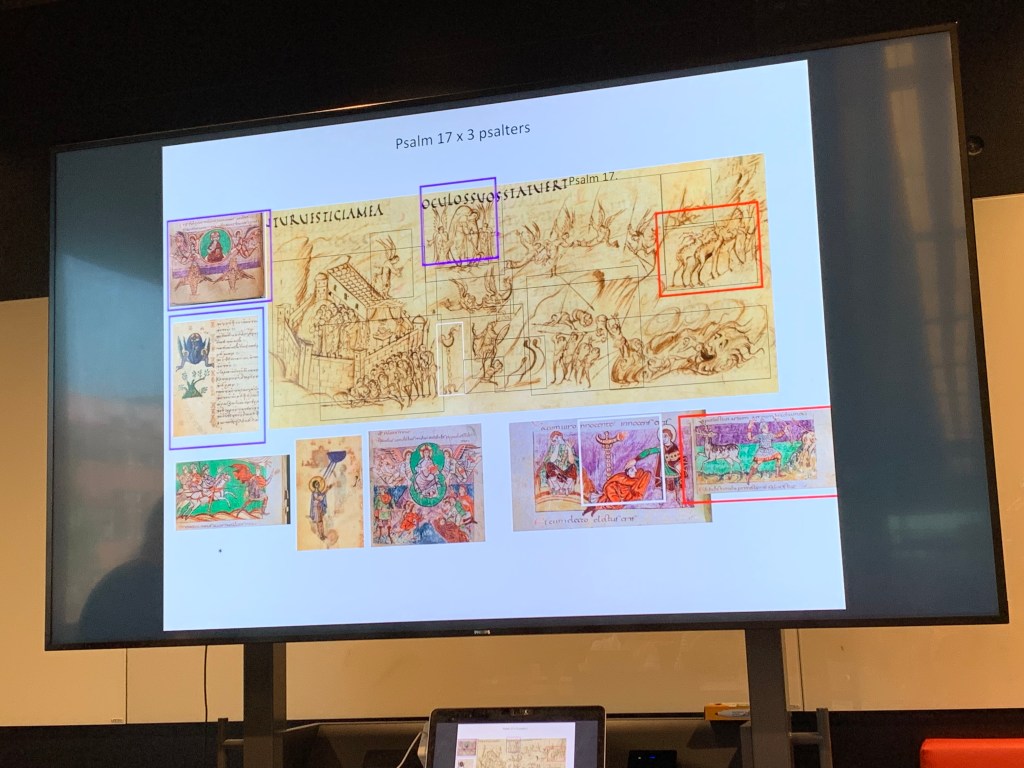
I am an MSc student at the University of Edinburgh studying the Global Premodern Art course, with a focus on medieval and early modern Northern Europe. This June, I had the chance to travel to the Netherlands and participate in a two-day workshop hosted by the Utrecht University Library. My supervisors, Heather Pulliam and Adam Cohen, brought together a diverse group of experts in the digital humanities, working across North America and Europe, to explore digital approaches to the Utrecht Psalter, an early medieval illustrated psalter with a number of mysteries which have puzzled historians for decades: What are its models? What are the correlations between its compositional patterns and its scribal hands? And what is its relation to other early medieval illustrated psalters? Although I had taken a seminar on the Utrecht Psalter during my undergraduate degree in Toronto, and had encountered DH in my graduate coursework in Edinburgh, I had never before considered how digital technologies might help us investigate these critical questions relating to iconography, layout, and the corpus of early medieval illustrated psalters.
Before we began to probe the digital realm for answers to our questions, each participant gave a brief presentation on their involvement in DH, detailing their approaches to the digital, which was at times philosophical, their perspective on the past and future of DH, as well as exciting new projects underway. We were introduced to projects such as eCodicesNL, DigitalMappa, Archetype, InnovatingKnowledge, Digital Scriptorium 2.0, the BASIRA Project, and Birgitta in England. Through these presentations, I learned about AI approaches to palaeography, ‘editorial archaeology’ (to borrow from Martin Foys), annotating and tagging images, new developments in IIIF, and the importance of open-source data and stable datasets. After having a lunch of sandwiches and salads and taking in the sights of Utrecht University’s colourful campus, we returned to discuss palaeography and the question of scribal hands. What struck me about this discussion is the sheer magnitude of data that might be involved in our psalter project. The manuscript would have to be turned from physical object to data, with specific inputs and outputs, so that we may work at these questions computationally. This necessitates a whole new way of thinking. Each element of the psalter image can be thought of as a unit, with identifiable attributes, and organized within a complete taxonomy. It was very interesting to me how much of this early stage of production is dependent on building a vocabulary for description. Spear, figure holding spear, figure. How incredible would it be to see every spear in all 166 illustrations cropped from their larger compositions, and placed side by side for comparison? What new questions might this generate?
On the second day, the group discussed network analysis and how it could expand upon earlier tubular approaches to comparing the entire corpus of early medieval illustrated psalters. All of the DH experts echoed this sentiment: one needs to decide what is important, in both the research questions and the data. What can be manually described in this sea of data is limited, and the questions that we ask of this technology must be incredibly specific in order to yield results. This digital framework compels the historian to sharpen their questions and concepts until they are clear enough to be implemented. I felt that this was an important lesson to learn as a student just wading into the world of DH and beginning to understand its limits and possibilities. DH is more than just a service which increases research efficiency or access, it is an entire methodology that necessitates new questions to be asked in its language.
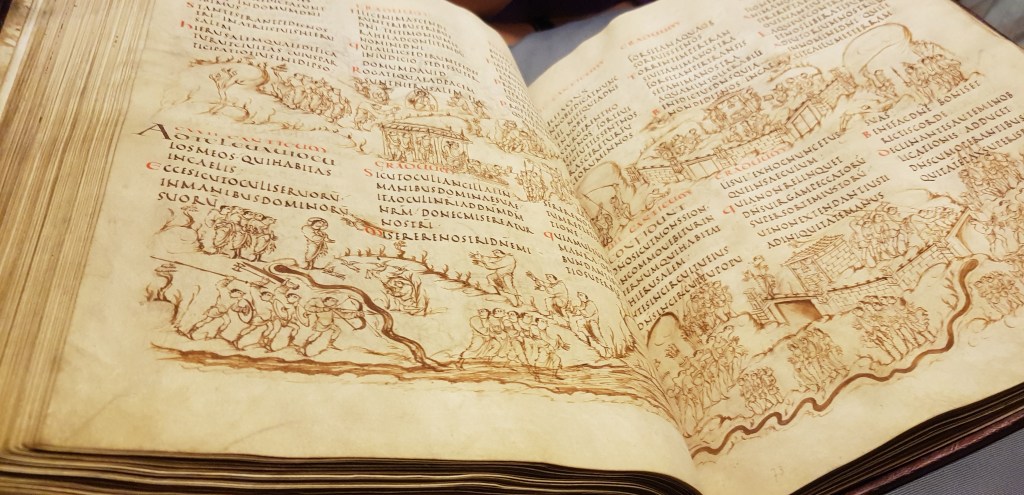
Later in the day, we had the once-in-a-lifetime opportunity to see the manuscript in the flesh. As Bart Jaski, keeper of manuscripts at Utrecht University, carefully flipped through its pages, I thought about how surreal it is to be in the presence of an object more than one thousand years old. He also pointed out details that usually go unnoticed in the digital version we have all become so familiar with, and we were able to appreciate the texture of the parchment, every prick on its surface, and the subtle differences in the strokes of ink from page to page. I even managed to snap a picture of fol. 88v, the canticle of Zacharias, which I wrote about in that very first seminar in Toronto—the beginning of my relationship with the Utrecht Psalter.
Over these two days, I learned so much about DH in such a short span of time. This experience was extremely meaningful to me as a student because not only was I able to be observe the beginning stages of a research project and learn about proposals, process and methodology, but I also had the incredible opportunity to learn from a number of amazing scholars in the field. Thank you to Bart Jaski, Edu Hackenitz, Martine Meuwese, Federico Rubini, Mariken Teeuwen, Stewart Brookes, Doug Emery, Martin Foys, Julia King, Evina Steinova, and of course Heather Pulliam and Adam Cohen for your staggering generosity. I am excited for the future of this project, and will be taking many of the lessons learned with me in my own future research endeavours.





 imagingthepsalter.com